
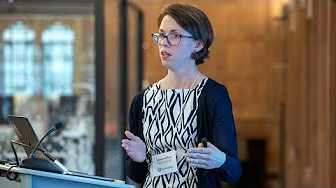
Machine Vision for Cultural Heritage & Natural Science Collections
The mass digitization of visual collections, on the order of hundreds of thousands or millions of images, creates new challenges for curators and researchers alike. The Yale-Smithsonian Partnership brings together scholars and curators from both institutions for conversations, demonstrations, and future partnerships.
Mungkin Anda Juga Suka
Kids Songs by CoComelon
The Original CoComelon Alphabet Series
Baby Learning with CoComelon - Colors, Shapes and Numbers!
Learn Colors with CoComelon!
KS2 Drama
KS3 Drama
Alphabet (ABC) Songs by CoComelon
Sheriff Labrador - Kids Cartoon | Safety Cartoon for Kids
Campus Chronicles
Learn English With Disney Movies
Test Your English with TV Series and Movies
CoComelon #shorts
All New Akili & Me
Centenario
CoComelon
SS 1 Mathematics
SS 1 Physics
Film Indonesia
China Business 101
Chinese for HSK 1
Computer Science
JJ & Friends by CoComelon
Year1 English
CoComelon & Friends Holiday and Christmas Videos for Kids | Little Baby Bum | Go Buster and More!
Komentar
10 Komentar
Susan Gibbons (University Librarian & Deputy Provost, Yale) The Yale-Smithsonian Partnership presents: Machine Vision for Cultural Heritage & Natural Science Collections The mass digitization of visual collections, on the order of hundreds of thousands or millions of images, creates new challenges for curators and researchers alike. Simultaneously, the rapid pace of industry innovation in deep learning (from guiding self-driving cars to captioning smartphone images) demands the attention of library, museum, and academic professionals. Existing practices of cataloging and description can be augmented by recent advancements in machine vision – and human expertise can likewise guide the development of future algorithms for the humanities and sciences alike. This event, held at the Franke Family Digital Humanities Laboratory in Yale’s Sterling Memorial Library, brings together scholars and curators from both institutions for conversations, demonstrations, and future partnerships. dhlab.yal
Jacob Kim (Hirshhorn, Smithsonian Institution) & Dan Michaelson (School of Art, Yale) The Yale-Smithsonian Partnership presents: Machine Vision for Cultural Heritage & Natural Science Collections The mass digitization of visual collections, on the order of hundreds of thousands or millions of images, creates new challenges for curators and researchers alike. Simultaneously, the rapid pace of industry innovation in deep learning (from guiding self-driving cars to captioning smartphone images) demands the attention of library, museum, and academic professionals. Existing practices of cataloging and description can be augmented by recent advancements in machine vision – and human expertise can likewise guide the development of future algorithms for the humanities and sciences alike. This event, held at the Franke Family Digital Humanities Laboratory in Yale’s Sterling Memorial Library, brings together scholars and curators from both institutions for conversations, demonstrations, and futu
Stephen Krewson (English, Yale) The Yale-Smithsonian Partnership presents: Machine Vision for Cultural Heritage & Natural Science Collections The mass digitization of visual collections, on the order of hundreds of thousands or millions of images, creates new challenges for curators and researchers alike. Simultaneously, the rapid pace of industry innovation in deep learning (from guiding self-driving cars to captioning smartphone images) demands the attention of library, museum, and academic professionals. Existing practices of cataloging and description can be augmented by recent advancements in machine vision – and human expertise can likewise guide the development of future algorithms for the humanities and sciences alike. This event, held at the Franke Family Digital Humanities Laboratory in Yale’s Sterling Memorial Library, brings together scholars and curators from both institutions for conversations, demonstrations, and future partnerships. dhlab.yale.edu/machine-vision
Adam Metallo (Digitization Program Office, Smithsonian Institution) The Yale-Smithsonian Partnership presents: Machine Vision for Cultural Heritage & Natural Science Collections The mass digitization of visual collections, on the order of hundreds of thousands or millions of images, creates new challenges for curators and researchers alike. Simultaneously, the rapid pace of industry innovation in deep learning (from guiding self-driving cars to captioning smartphone images) demands the attention of library, museum, and academic professionals. Existing practices of cataloging and description can be augmented by recent advancements in machine vision – and human expertise can likewise guide the development of future algorithms for the humanities and sciences alike. This event, held at the Franke Family Digital Humanities Laboratory in Yale’s Sterling Memorial Library, brings together scholars and curators from both institutions for conversations, demonstrations, and future partnerships. d
Catherine DeRose (DHLab, Yale) The Yale-Smithsonian Partnership presents: Machine Vision for Cultural Heritage & Natural Science Collections The mass digitization of visual collections, on the order of hundreds of thousands or millions of images, creates new challenges for curators and researchers alike. Simultaneously, the rapid pace of industry innovation in deep learning (from guiding self-driving cars to captioning smartphone images) demands the attention of library, museum, and academic professionals. Existing practices of cataloging and description can be augmented by recent advancements in machine vision – and human expertise can likewise guide the development of future algorithms for the humanities and sciences alike. This event, held at the Franke Family Digital Humanities Laboratory in Yale’s Sterling Memorial Library, brings together scholars and curators from both institutions for conversations, demonstrations, and future partnerships. dhlab.yale.edu/machine-vision
Alex White (NMNH & Data Science Lab, Smithsonian Institution) The Yale-Smithsonian Partnership presents: Machine Vision for Cultural Heritage & Natural Science Collections The mass digitization of visual collections, on the order of hundreds of thousands or millions of images, creates new challenges for curators and researchers alike. Simultaneously, the rapid pace of industry innovation in deep learning (from guiding self-driving cars to captioning smartphone images) demands the attention of library, museum, and academic professionals. Existing practices of cataloging and description can be augmented by recent advancements in machine vision – and human expertise can likewise guide the development of future algorithms for the humanities and sciences alike. This event, held at the Franke Family Digital Humanities Laboratory in Yale’s Sterling Memorial Library, brings together scholars and curators from both institutions for conversations, demonstrations, and future partnerships. dhlab.y
Douglas Duhaime (DHLab, Yale) The Yale-Smithsonian Partnership presents: Machine Vision for Cultural Heritage & Natural Science Collections The mass digitization of visual collections, on the order of hundreds of thousands or millions of images, creates new challenges for curators and researchers alike. Simultaneously, the rapid pace of industry innovation in deep learning (from guiding self-driving cars to captioning smartphone images) demands the attention of library, museum, and academic professionals. Existing practices of cataloging and description can be augmented by recent advancements in machine vision – and human expertise can likewise guide the development of future algorithms for the humanities and sciences alike. This event, held at the Franke Family Digital Humanities Laboratory in Yale’s Sterling Memorial Library, brings together scholars and curators from both institutions for conversations, demonstrations, and future partnerships. dhlab.yale.edu/machine-vision
Peter Leonard (DHLab, Yale) The Yale-Smithsonian Partnership presents: Machine Vision for Cultural Heritage & Natural Science Collections The mass digitization of visual collections, on the order of hundreds of thousands or millions of images, creates new challenges for curators and researchers alike. Simultaneously, the rapid pace of industry innovation in deep learning (from guiding self-driving cars to captioning smartphone images) demands the attention of library, museum, and academic professionals. Existing practices of cataloging and description can be augmented by recent advancements in machine vision – and human expertise can likewise guide the development of future algorithms for the humanities and sciences alike. This event, held at the Franke Family Digital Humanities Laboratory in Yale’s Sterling Memorial Library, brings together scholars and curators from both institutions for conversations, demonstrations, and future partnerships. dhlab.yale.edu/machine-vision
Holly Rushmeier (Computer Science, Yale) The Yale-Smithsonian Partnership presents: Machine Vision for Cultural Heritage & Natural Science Collections The mass digitization of visual collections, on the order of hundreds of thousands or millions of images, creates new challenges for curators and researchers alike. Simultaneously, the rapid pace of industry innovation in deep learning (from guiding self-driving cars to captioning smartphone images) demands the attention of library, museum, and academic professionals. Existing practices of cataloging and description can be augmented by recent advancements in machine vision – and human expertise can likewise guide the development of future algorithms for the humanities and sciences alike. This event, held at the Franke Family Digital Humanities Laboratory in Yale’s Sterling Memorial Library, brings together scholars and curators from both institutions for conversations, demonstrations, and future partnerships. dhlab.yale.edu/machine-visio
Rebecca Dikow (Data Science Lab, Smithsonian Institution) The Yale-Smithsonian Partnership presents: Machine Vision for Cultural Heritage & Natural Science Collections The mass digitization of visual collections, on the order of hundreds of thousands or millions of images, creates new challenges for curators and researchers alike. Simultaneously, the rapid pace of industry innovation in deep learning (from guiding self-driving cars to captioning smartphone images) demands the attention of library, museum, and academic professionals. Existing practices of cataloging and description can be augmented by recent advancements in machine vision – and human expertise can likewise guide the development of future algorithms for the humanities and sciences alike. This event, held at the Franke Family Digital Humanities Laboratory in Yale’s Sterling Memorial Library, brings together scholars and curators from both institutions for conversations, demonstrations, and future partnerships. dhlab.yale.