
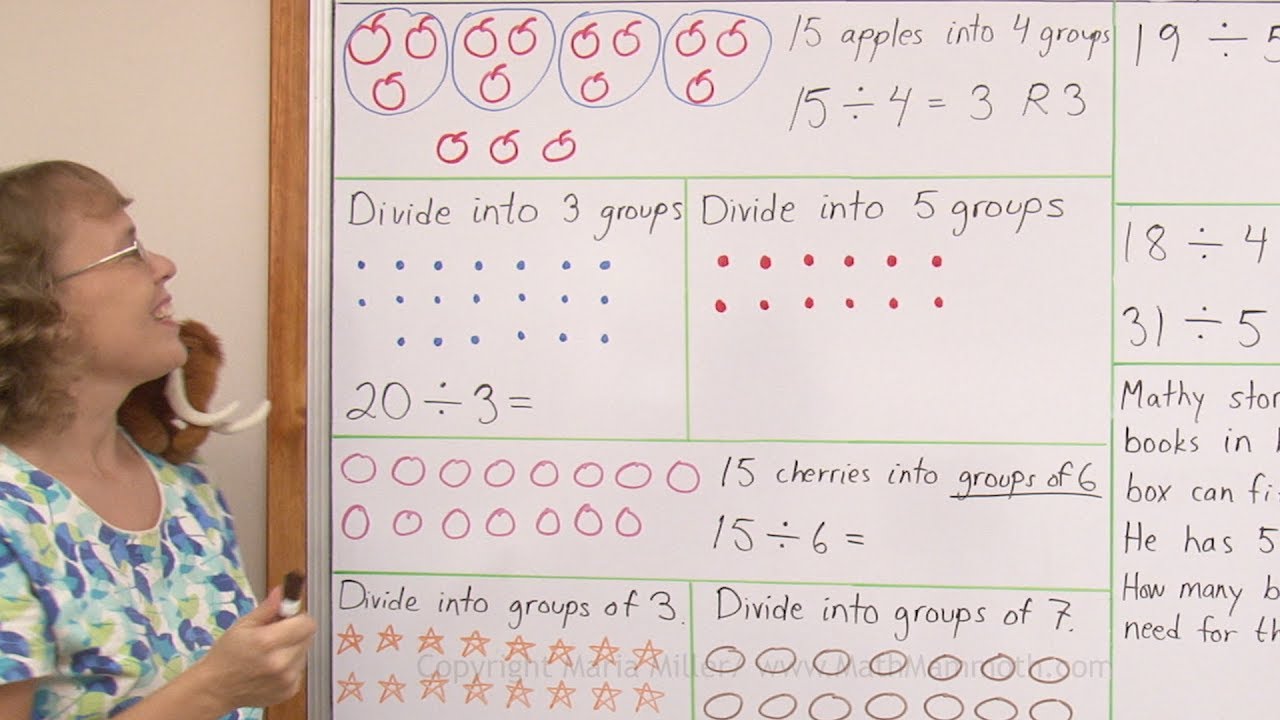
This is a beginner lesson where we look at visual models to understand what is REMAINDER in division. The first examples have to do with sharing division, and the latter ones with "measurement" division (where you know the size of the groups). Either way, the remainder is the "leftovers" -- the items that cannot be evenly divided into groups. I also emphasize how we can check a division problem with a remainder by MULTIPLYING -- and then adding in the remainder. All of this is done with mental multiplication and mental math - no long division. Check out also the NEXT lesson where we practice finding remainders in division: This lesson is meant for 3rd or 4th grade math.
आपको ये भी पसंद आ सकते हैं
Year 11 Math
Year7 Maths
Year 4 Math
Year 3 Math
Kids Songs by CoComelon
CoComelon
Learn English With Disney Movies
The Original CoComelon Alphabet Series
KS2 Drama
KS3 Drama
Alphabet (ABC) Songs by CoComelon
Sheriff Labrador - Kids Cartoon | Safety Cartoon for Kids
Year1 Maths
Year2 Maths
Year4 Maths
SSS10 Math
Year 10 Math
Year5 Maths
Maths
Numberblocks - Learn to Count | Maths for Kids
PrePrimary Maths
Math Videos for Kids
Seconde - Généralités sur les Fonctions
Системы уравнений и неравенств
टिप्पणियाँ
10 टिप्पणियाँ
A basic explanation of what AVERAGE means in math - we take a bunch of numbers and consider their sum, and sort of "even them out" so that the sum remains the same. To find the average, you add up all your numbers and divide by however many there are. Then I use the concept of average to solve a few word problems, including one where we need to use a bar graph, and another where we need to give an estimate based on the calculated average.
This video helps students to understand what the answer (quotient) and the remainder mean in the context of various word problems (where we need to use long division). This is especially important when items are packaged into containers. When there are "leftovers" (a remainder), then those leftover items may need to go to a container also, though it will not be full.
Learn the continued subtraction algorithm for division (aka chunking), by using the example of bagging apples. My first example is to bag 771 apples in bags of 3. Subtracting three apples at a time (and keeping a count of the bags used) would be slow, so instead, we subtract 300 apples (which go to 100 bags) at once. The number of bags then is the answer to the original division problem (the quotient). I refine the algorithm yet a bit more, until we arrive to the one that exactly matches the steps in long division! The last example shows a comparison where I solve the same problem BOTH with continued (repeated) subtraction and long division. This lesson is meant for about 5th grade math; whenever students are learning about long division and why it works.
How do you find 3/7 of 56? The idea is, we first find 1/7 of 56, which is the DIVISION problem 56 / 7 = 8. Then, 3/7 of the quantity is three times that (three groups out of the seven), or 24. First I show you this concept (finding a fractional part of a quantity) using pictures ,and then we work through some problems without pictures. This lesson is suitable for 4th grade math and onward.
A quick example of doing long division with a dollar amount. The division works the same; we simply place a decimal point in the answer in the same place as it is in the dividend. See more 4th grade math videos at https://www.mathmammoth.com/videos/grade_4/math_videos_4th_grade Math Mammoth Division 2 worktext focuses on the topics of long division, remainder, problem solving, average, divisibility, and factors. https://www.mathmammoth.com/division_2
A quick example of a long division problem where we end up with a zero in the quotient. See more 4th grade math videos at https://www.mathmammoth.com/videos/grade_4/math_videos_4th_grade Math Mammoth Division 2 worktext (long division, remainder, average, word problems): https://www.mathmammoth.com/division_2
A short video showing the procedure of long division with a four-digit and a five-digit dividend. See also: 2-digit long division https://www.youtube.com/watch?v=Ei71Jrt0HyE 3-digit long division https://www.youtube.com/watch?v=MtrEZcPeY7o More math videos for 4th grade at https://www.mathmammoth.com/videos/grade_4/math_videos_4th_grade
A quick example where I show the steps of long division for a 3-digit number.
I go through two examples of long division with two-digit numbers. Then I also show one three-digit division where we first divide into the first two digits of the dividend... so essentially, the division has as many steps as a two-digit division. Find more math videos for 4th grade at https://www.mathmammoth.com/videos/grade_4/math_videos_4th_grade
Learn the first steps in long division: the actual long division SYMBOL (I like the Finnish name for it... a long division "corner"), and then how to divide 2-digit numbers with remainders. Practice long division online: https://www.mathmammoth.com/practice/long-division This lesson is part of the Math Mammoth Grade 4 Curriculum. Learn more here: https://www.mathmammoth.com/complete/grade_4