
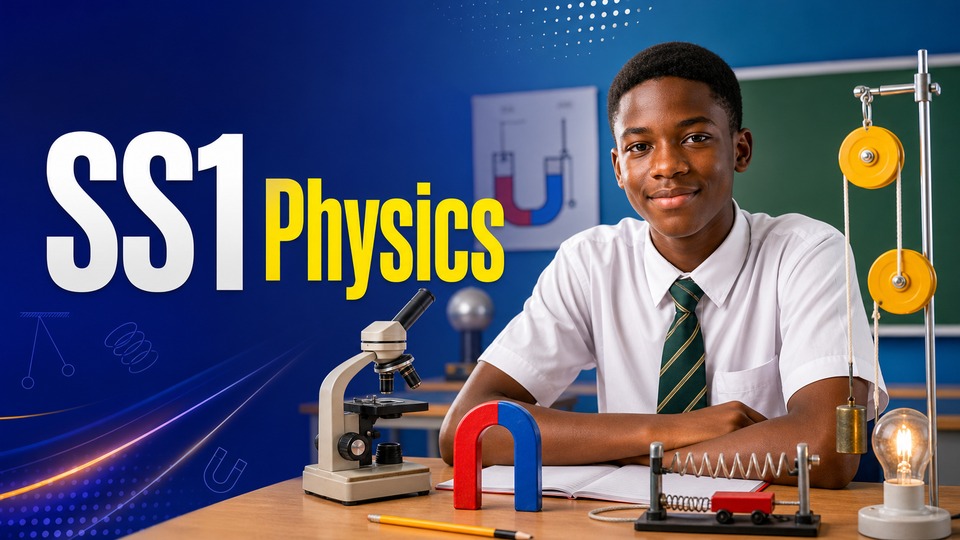
Interaction Of Matter, Space And Time Conservation Principles Field At Rest And In Motion Energy Quantization And Quality Of Matter Physics In Technology EXPANSION IN LIQUID
Vous aimerez aussi
SS 1 Chemistry
SS 1 Mathematics
SS 1 Business & Finance
JS 2 Mathematics
SS 3 Physics
SS 2 Physics
SS 2 Physical
SS 3 Physical
6ème - La planète Terre
🔵 1ère spé - Lentilles minces convergentes
Class 10 Physics Video Lessons
Class 11 Physics for JEE Main, JEE Advanced & NEET | Onion Physics
Photoelectric effect
10th Class Physics Chapter 11 - Class 10 Physics Chapter 1 - Physics Class 10 Chapter 11
Doppler Effect
11 Physics | Work Energy Power
JS 3 Mathematics
SS 2 English
Primary 5 English
Celebrating STEM: counting and multiplication
SS 1 Physics
SS 1 Physical
SSS12 Physical
SSS11 Physical
Commentaires
10 commentaires
At the end of this lesson, student should be able to:.
At the end of this lesson, student should be able to:.
At the end of the lesson, the student should be able to understand X-Ray
At the end of the lesson, the student should be able to understand X-Ray
Students to: Explain the structure and states of matter. Measure the size of a molecule as a class activity Distinguish between crystalline and non-crystalline substances giving examples. Mention the particle properties of photons.
Students to: Explain the structure and states of matter. Measure the size of a molecule as a class activity Distinguish between crystalline and non-crystalline substances giving examples. Mention the particle properties of photons.
Students to: Explain the structure and states of matter. Measure the size of a molecule as a class activity Distinguish between crystalline and non-crystalline substances giving examples. Mention the particle properties of photons.
Students to: Explain the structure and states of matter. Measure the size of a molecule as a class activity Distinguish between crystalline and non-crystalline substances giving examples. Mention the particle properties of photons.
Students to: Explain the structure and states of matter. Measure the size of a molecule as a class activity Distinguish between crystalline and non-crystalline substances giving examples. Mention the particle properties of photons.
Students should be able to: Formulate simple hypothesis and test them before they can draw conclusions based on specific information. Explain how molecules of a substance move relative to other molecules of the same substance Describe the atomic structure of matter State the constituents of the atom Use molecular theory to explain the three states of matter. Describe the structure of simple crystals. Distinguish between crystalline and amorphous substances Use the concept of photon to explain that light behaves like particle.