
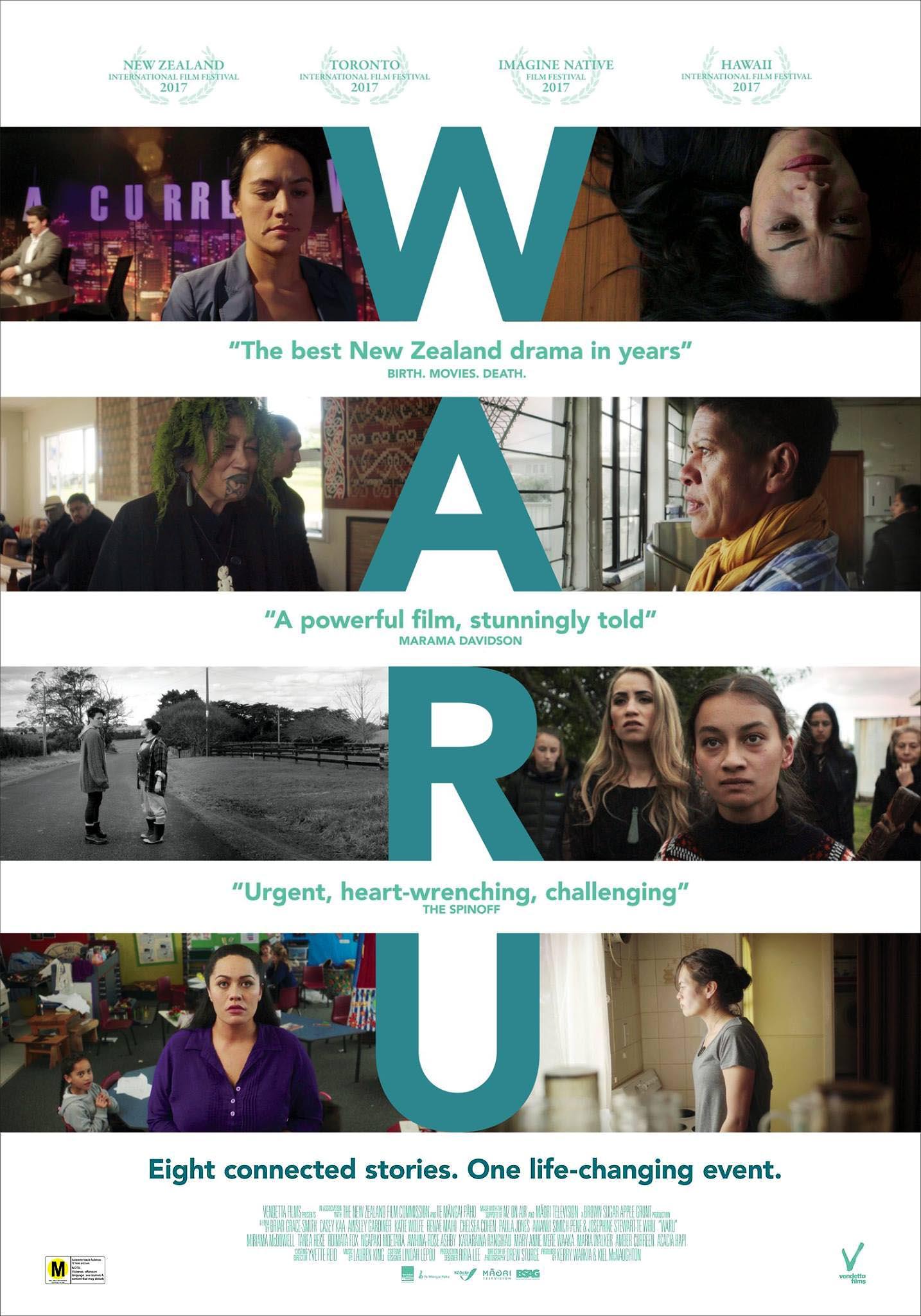
A powerful, challenging story surrounding the tangi (funeral) of a small Waru boy who dies at the hands of his caregiver and how his death impacts the community.
الإعلان الترويجي
طاقم العمل
Ainsley Gardiner
Director
Casey Kaa
Director
Renae Maihi
Director
Awanui Simich-Pene
Director
Briar Grace Smith
Director
Paula Whetu Jones
Director
Chelsea Winstanley
Director
Katie Wolfe
Director
Tanea Heke
Charm
Roimata Fox
Anahera
Ngapaki Moetara
Mihi
Awhina-Rose Ashby
Em
Kararaina Rangihau
Ranui
Merehaka Maaka
Hinga
Maria Walker
Kiritapu
Acacia Hapi
Mere
Miriama McDowell
Bash
Amber Curreen
Titty
Ameleiyah-Medow
Baby Karena
Fasitua Amosa
Mo
Nesian Asafo
Jack
Christina Asher
Nanny
Kahukore Bell
Orini
Krystal-Lee Brown
Abbey
Jonny Brugh
Richard
Joe Dekkers-Reihana
Tops
Ainsley Gardiner
Writer
Casey Kaa
Writer
Renae Maihi
Writer
Briar Grace Smith
Writer
Josephine Stewart-Te Whiu
Writer
Paula Whetu Jones
Writer
Katie Wolfe
Writer
قد يعجبك أيضًا
Waru
مركبة
6 Days
Born to Dance
Friends Like Her
Double Parked
Mean Mums
الذئب المراهق
Beauty in Black
لعبة الحبار
قوة
Into the Badlands
الساحر
Outlaws
العميل الليلي
Madam
Offspring
Plum
Black Comedy
Roast Night
الفريق سيل
Adulting
البيت الورقي
The Four Of Us
التعليقات
6 تعليق
source: Waru
It is entirely too easy for anyone to rate films like this. Rate them low or mediocre, to critique on the child actors who have only a few seconds on screen, to try to say indigenous peoples used clichés about themselves (patently absurd because it is self-knowledge not a stereotype), the sound levels or camera angles. Not that there might not be legitimate technical complaints in a film such as this. I am not from the community of the main peoples portrayed, but I am a person of color with indigenous heritage, who has researched, live and learned more than average of accurate history and the connection of things like invasion, colonization, forced assimilation and appropriation and how it affected the native populations. So much of the western society are oblivious to this reality or they downplay it with derision as they live on land that was stolen. Places where the Original peoples still struggle, not because they are monolithic or incapable, but because they were profoundly interrupted by Europeans then, if surviving genocide, now live with discrimination, stereotyping on in their own land but where everything around them, from lessons taught in school or the cabbie who makes this pay first unlike white customers, is strategically or inadvertently made to lessen them. Most do not see how all of these things are interconnected, and the dysfunctions, the abuses, the deaths while not directly their fault, they benefit from and their presence and willful privilege minimizes. And so, when a profound story is told from an indigenous perspective, unless it somehow reaches or emulates a Euro-created interpretation of indigenous issues, it is deemed passé, always compared to a baseline of Eurocentricity. The series of short films are terrific in it's portrayal of the ranges of reactions to the death of a small boy of a very interconnected and interactive community. Such an unfortunate event can occur in any community around the world, any social level, but this gain insight into a Maori community with the complexity of needs, accents, prejudices and posturing...or complete honesty that happen in the aftermath of such a tragedy. Take with empathy, respect what the director and participants, which although a fictional film, draws from deeply personal, painful experiences. But that doesn't matter just like my review, and basic entreaty to be empathetic and a Human Being. A message of indigenous reality to mainstream Euro-ruled society in places like the US and New Zealand, which needs to nbe heard and understood, is too often rejectedor minimized because of having privilege to ignore it or use terms like "awful cliché", when that shows they do not even understand the difference when someone from WITHIN a community presents themselves as they see it, and when someone not from that community, like non-indigenous use a stereotype to describe the indigenous.
The stupidest movie I have ever seen. It made absolute nonsense to me AT ALL! I don't believe that anyone understood it but just don't want to admit it so they talk about how amazing it is. Pure crap.
Waru has been lauded as a great New Zealand film, but that's an oversimplification and you need to be prepared for the practicalities. It is eight connected short films, with different writers, directors and performers in each. That has the inevitable consequence of producing eight very different pieces, some of which are superb. I went into Waru knowing what the central event was, so expected it to be tough to watch and it was, though, at times, that was more about the variation in quality on the screen than the topic. It is important to provide opportunities to make films, how else will people learn? What's unusual here is that we see intelligent, beautifully crafted work alongside writing and or performances that were genuinely disappointing. The contrast between some shorts was jarring. Should you go and see Waru? Absolutely, yes. Will you have to forgive it periods of awful cliché and direct exposition in the mouths of characters? Yes. Does it redeem itself with simplicity, complexity, honesty, courage, power and leave you with a haunting personal challenge? Yes.
Waru