
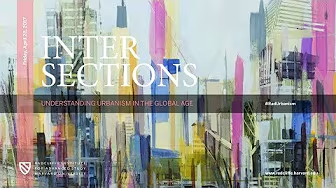
Urbanism is a global phenomenon, presenting us with a range of pressing issues to consider: economic, political, material, and—most of all—human. Our conference was designed to stimulate a broad-based discussion about “the urban” in the 21st century, a much more complicated concept than 19th- and 20th-century cities. This change has been much studied by social scientists, but we often overlook how these new urban centers are being experienced by their inhabitants. This Radcliffe Institute conference takes multidisciplinary and international approach to explore the challenges and tensions that people in urban communities face today.
Mungkin Anda Juga Suka
SEAS Videos
SEAS Graduate Students
Harvard Kennedy School: Ask What You Can Do
Kids Songs by CoComelon
SEAS Campaign Videos
SEAS Undergraduate Videos
Saving Lives That Give Life | HSPH
6th Annual New England Tuberculosis Symposium | HGHI
SS 1 Chemistry
SS 3 Physics
SS 2 Biology
Learn English with Movies
CoComelon Lane | NEW Netflix Kids Show
ABC Videos: Write the Letter - Alphabet Writing Lessons for Children
CoComelon | Netflix Jr
Introduction to Artificial Intelligence (AI)
CoComelon
Alphabet (ABC) Songs by CoComelon
CocoMelon | Little Baby Bum | Blippi - Nursery Rhymes & Kids TV Shows
Learn English With Disney Movies
CoComelon - Happy Holidays
BabyBus | Learning Vehicles Song | Car Songs | Cars for Kids | Nursery Rhymes | Baby Cartoon
Educational Videos for Children - Lingokids
The Original CoComelon Alphabet Series
Komentar
4 Komentar
PLANNED AND UNPLANNED Official city plans are often not realized in their proposed forms, but rather adapt to realities on the ground, including unexpected practices and patterns of human behavior. Edgar Pieterse (08:11), South African research chair in urban policy and director, African Centre for Cities, University of Cape Town (South Africa) Ana Elvira Vélez Villa (26:58), architect (Colombia) Ricky Burdett (43:15), professor of urban studies and director, LSE Cities, the London School of Economics and Political Science Moderator: Eve Blau, co–principal investigator, Harvard-Mellon Urban Initiative; adjunct professor of the history and theory of urban form and design, Harvard Graduate School of Design PANEL DISCUSSION (1:06:09) AUDIENCE Q&A (1:22:19) CLOSING REMARKS (1:35:22) Julie A. Buckler
BEYOND THE NATURE/TECHNOLOGY DIVIDE This panel looks at the intertwined workings of nature and technology in urban infrastructure, green spaces, public art, and landscape design. Dilip da Cunha (4:24), adjunct professor, Department of Landscape Architecture and Regional Planning, University of Pennsylvania Anna Schuleit Haber (18:33), visual artist Matthias Schuler (33:25), founder, Transsolar KlimaEngineering, and Anja Thierfelder, architect (Germany) Moderator: Erik Ghenoiu, research manager, Harvard-Mellon Urban Initiative PANEL DISCUSSION (55:10) AUDIENCE Q&A (1:08:48)
WAYS OF KNOWING THE CITY This panel explores how urban environments offer a dense and intense human experience, while also being a complex object of study generating vast quantities of data for analysis. Heidi Ewing (4:35), filmmaker; codirector of the Emmy Award–winning film Detropia Mark Shepard (23:40), associate professor, Departments of Architecture and Media Study, School of Architecture and Planning, University at Buffalo Sooni Taraporevala (43:13), photographer; award-winning screenwriter (Mississippi Masala, Salaam Bombay!, The Namesake) and director (Little Zizou) Moderator: Julie A. Buckler, faculty director of the Humanities Program at the Radcliffe Institute; co–principal investigator, Harvard-Mellon Urban Initiative; Samuel Hazzard Cross Professor of Slavic Languages and Literatures and of Comparative Literatures in the Faculty of Arts and Sciences, Harvard University PANEL DISCUSSION (58:39) AUDIENCE Q&A (1:10:24)
WELCOME Lizabeth Cohen, dean of the Radcliffe Institute and Howard Mumford Jones Professor of American Studies, Harvard University KEYNOTE (9:57) Angela Flournoy, author of The Turner House; Rona Jaffe Foundation Fellow at the New York Public Library Dorothy and Lewis B. Cullman Center for Scholars and Writers AUDIENCE Q&A (41:47)