
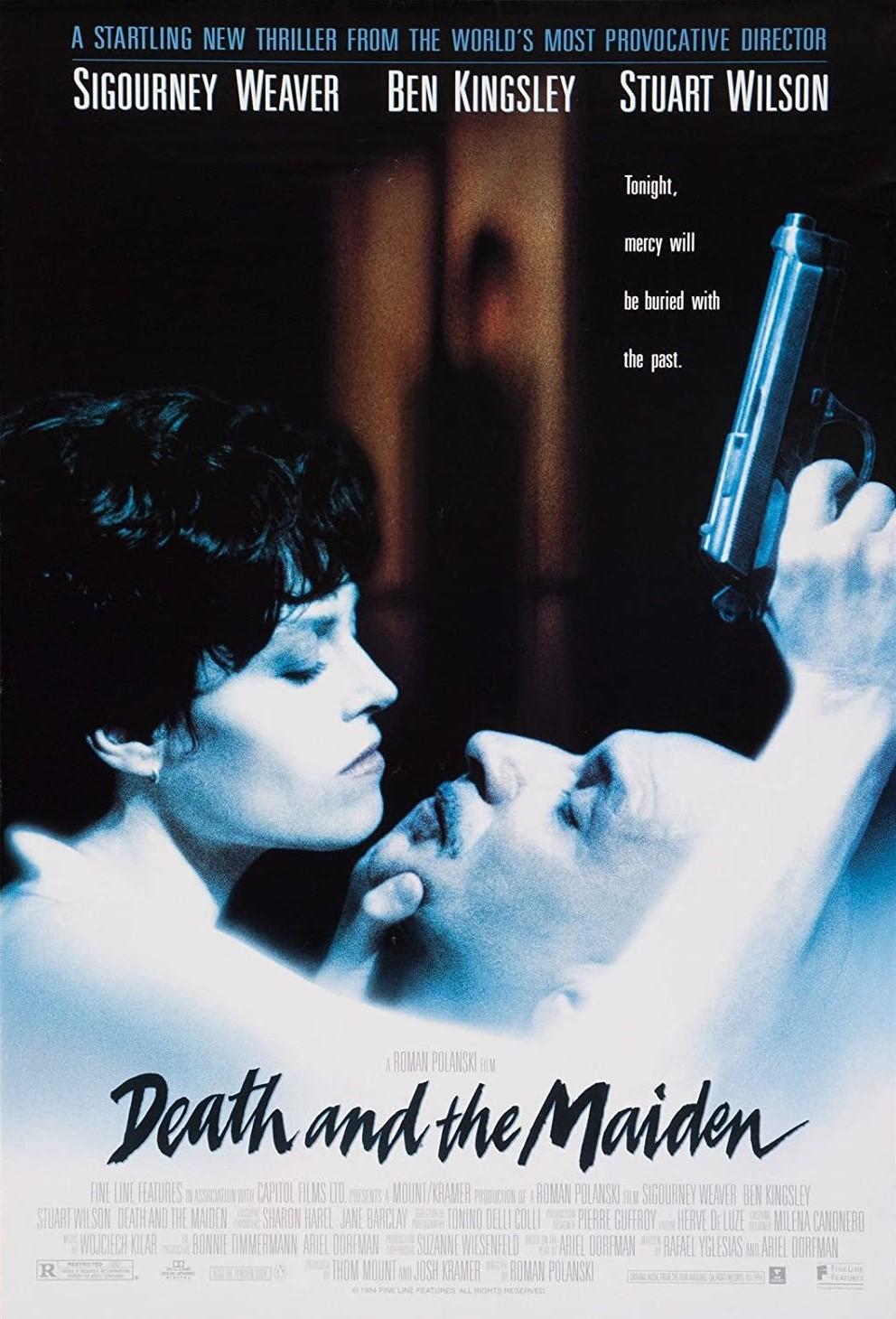
A political activist is convinced that her guest is a man who once tortured her for the government.
Trailer
Pemeran
Roman Polanski
Director
Sigourney Weaver
Paulina Escobar
Ben Kingsley
Dr. Roberto Miranda
Stuart Wilson
Gerardo Escobar
Krystia Mova
Dr. Miranda's Wife
Jonathan Vega
Dr. Miranda's Son
Rodolphe Vega
Dr. Miranda's Son
Gilberto Cortés
String Quartet Player
Jorge Cruz
String Quartet Player
Carlos Moreno
String Quartet Player
Eduardo Valenzuela
String Quartet Player
Sergio Ortega Alvarado
String Quartet Manager
Karen Strassman
Elena Galvin
Ariel Dorfman
Writer
Rafael Yglesias
Writer
Mungkin Anda Juga Suka
Another Me
Based on a True Story
Balik Taya
The Wrong Bed: Naked Pursuit
Behind Her Eyes
Taboo
Red Eye
The Stolen Girl
Disclaimer
All the Queen's Men
Lucifer
The Wife
Snowfall
Riviera
The Woman in the Wall
Doctor Foster
The Pact
The Cry
Born to Kill
The Hunting Wives
Yellowjackets
The Beast in Me
The Tailor
Echoes
Komentar
10 Komentar
Criminals are punished morally by their conscience and legally by the state. What about state-sanctioned crimes? Not only may the victim no longer have much faith in "the state" to essentially police itself but also the "state-sponsored" perpetrator may feel morally innocent. The unforgettable stories of outrageous evil in Polanski's "Chinatown" and "Rosemary's Baby" were arguably overshadowed by the incomparable acting and direction. Here the presentation, although good, is more conventional, so the plot takes center stage, with the focus, as I saw it, on retribution and psychological guilt/innocence. Does the ending depict justice? It seems unrealistic, but maybe was intended to highlight some of the limitations of a justice system for addressing the fundamental causes and effects of violence.
!!SPOILER ALERT!! !!SPOILER ALERT!! I was glued to the screen for the whole movie, and I'm happy that the ending gave a worthy payoff. Paulina is by far the strongest person in that house. Even though Gerardo loves her, he also envies and resents her, because she is so much stronger than he is. He tells Dr Miranda how she saved his life by not giving up Gerardo's name, even under torture, and Gerardo knew he would have confessed everything right away. Paulina thinks he gave up too much in order to get appointed to the investigating committee- he agreed to only look at cases where people died, which to her was a betrayal of all the torture survivors. Gerardo vacillates weakly through the whole movie. He typifies all people who cannot bring themselves to take unpleasant, decisive action against other people, so he's always pinned on the very uncomfortable horns of his own dilemmas. He cannot accept the necessity of killing Dr Miranda to save himself and Paulina, even though Dr Miranda himself recognized the necessity- if he's innocent, they've committed a serious crime against him. If he's guilty, he deserves death, and by kidnapping him they've compromised any potential legal case against him. Either way, they must kill him to save themselves. But Gerardo does not have the strength to face this. Paulina is matter-of-fact- "we have to kill him." Gerardo's character suggests why evil people always seem to succeed- they have no such restraints, and the law fails victims of crimes. At the end, when Dr Miranda finally confesses, Paulina sees that he too is a victim. A morally weak man who got sucked into becoming a torturer, and who discovered he liked it. Paulina is the only "pure" character in the movie; her clarity of moral vision remains steadfast. And, she kept her word- she said she would let him go if he confessed. When she got a genuine confession, when he admitted what he had done, and vindicated everything Paulina said, that was her liberation. No more excuses from the likes of Gerardo- he could no longer deny her experiences and judgement. She no longer has to protect him by not telling him everything. Gerardo, in his own way, is as weak as Dr Miranda. He would rather disbelieve Paulina than believe Dr Miranda is her torturer, because believing Paulina means he has to do something about it. His weak blathering about "the law" and process is priceless. Edmund Burke had people like Gerardo in mind when he said “All that is necessary for the triumph of evil is that good men do nothing.” The final scene sums up everything, without a single word of dialog. All three are attending a live performance of "Death and the Maiden." Paulina looks up and makes eye contact with Dr Miranda, who is sitting in the balcony with his family. She's not happy to see him, but she has found a measure of peace. Gerardo sees him, and suddenly he looks like he's sitting on spikes. Ben Kingsley is such a wonderful actor- the look he gives Paulina is a combination of "we have a special bond from our shared experiences," and the type of gratitude that a torture victim displays to a captor who shows him any kindness. Great movie, great performances.
Three characters, one suffocating place. The bizarre world of Roman Polanski transported to a true, painful and little known historical context. The film is an X ray into secret, open wounds. We're never sure what happens in Sigourney's mind, but we're aware that her pain and her anger are real. We are unable to take sides, we're too afraid. We want for the ordeal to end and yet, we're glued to the discomfort and uncertainty. Recommended for masochists and film lovers.
As I am a fan of Polanski's work I really wanted to see this film.But it was a little bit of a let down.Despite the acting capabilities of Sigourney Weaver and Ben Kingsley it just doesn't work very well. The most important point is the slow pace of the movie and the rather empty story.The script could have been much better worked out and it's a shame that this didn't happen.Polanski has given us the chills with acclaimed thrillers like "Frantic","Rosemary's Baby" and especially "Repulsion" which is his best movie together with "The Pianist".The tension,intensity and simplicity of "Repulsion" is never present in "Death and the Maiden". A major critic point is the fact that all so called South Americans all talk English and,even worse,they look English.This takes away the realistic view something that also bothered me with "The Pianist". The acting is fine though,especially Ben Kingsley comes up with a very powerful and convincing role. The music is repetitive as it is meant to:"Death and the Maiden" is a piece by Schubert. Still,Roman Polanski can do much better than this as he showed with "Repulsion". 6/10
Death and the Maiden is a thriller. A woman who had been tortured in a repressive government meets a man who has been her torturer, or has he? It is also a psychological film. A married couple deals with uncovering the whole truth about their past. And it is political. Although it is supposed to be a fictional story, it has more than a strong resemblance with the brutal tortures during Pinochet's dictatorship in Chile. It is not filmed in that country, but they use Chilean money, they eat Chilean bread and they mention Tavelli, a popular café in Santiago. Beautiful music. Schubert's Death and the Maiden, is played throughout the movie. A great film to view with people who enjoy having discussions after. Enjoy!
This movie, Death and the Maiden, is a remarkable production given that it is a stage drama put on film. There is virtually only one set. The actors are incredible. You never lose the essence of the Director, Roman Polanski. Your interest never wanes in this thriller. Sigourney Weaver is outstanding. She is shattered by her initial confrontation with her torturer, Ben Kingsley. And then her recalling of the atrocities at his hands gives her tremendous strength, the strength of a tiger. The climax is unsettling but proves the virtue of forgiveness and acceptance even with extreme misgivings. This is a movie that stays in your memory. Kudos to all concerned.
A woman who was tortured by a fascist regime never got over the fear it instilled in her. Years later she thinks she recognizes her chief interrogator as he visits her home. She ties him up and begins a psychological interrogation, trying to get him to admit his guilt. Her husband waffles back and forth between believing the man is guilty and then wondering if he is innocent. The viewer is left wondering about the man's guilt or innocence until almost the last frame. Intensely dramatic, I was unable to take my eyes off the screen. 5 stars.
I was shocked by this film. If not for the final opera scene, where there were hundreds of opera spectators, the whole film had only 3 actors!!!!! And the whole story line is that the woman is adamant about her belief. There was almost no story, but a collection of struggle scenes. A bit like 'Home Alone', but lacking the charm and humour. It was such a terrible bore. I wonder why the film was funded in the first place. There is nothing in the film that would captivate the viewers. And it costs millions to make?? In a film that has only basically one filming location and 3 actors? Where did the money go? Avoid this film!!
Considering that there were very few characters in the movie, it was a great effort on the part of all involved. Sigourney Weaver had me convinced that Ben Kingsley was her man.On the other hand, Ben had me convinced that he was not. I thoroughly enjoyed the swinging of belief from one person to another. These are the best type of movies. They always keep you guessing. The best thing was that it mostly took place in that one room. Yum yum, from start to finish.