
Mungkin Anda Juga Suka
🎬⭐️ BRAND NEW Episodes | Talking Tom Shorts: Season 3 🤣💙
Learn about Safety Tips for Kids!
English with TV Series (Kids Appropriate)
Special Videos
Kids Songs by CoComelon
CoComelon
Baby Learning with CoComelon - Colors, Shapes and Numbers!
Learn Colors with CoComelon!
Alphabet (ABC) Songs by CoComelon
Educational Videos for Children - Lingokids
BabyBus | Learning Vehicles Song | Car Songs | Cars for Kids | Nursery Rhymes | Baby Cartoon
SS 2 Biology
Learn English With Disney Movies
Test Your English with TV Series and Movies
CoComelon #shorts
All New Akili & Me
Charlie and Lola Full Episodes
Sheriff Labrador Popular Live Stream
How to Be a Better Human
Numberblocks & Alphablocks - Learn to read and count #readingmonth
Imperial White City Campus
1.8 МЕХАНИКА ТВЁРДОГО ТЕЛА 1
SS 1 Chemistry
Sheriff Labrador - Kids Cartoon | Safety Cartoon for Kids
Komentar
8 Komentar
Título: English Communication. Academic posters Descripción: Vídeo acerca del proceso de creación de un póster académico Seiz Ortiz, R. (2021). English Communication. Academic posters. Descripción automática: In this video, the presenter from the department outlines the fundamentals of creating an academic poster. The definition, main elements, characteristics, structure, and tips for crafting an effective poster are discussed. An academic poster serves as a graphic representation of academic or scientific work, often displayed at conferences and workshops to convey research results or specific technical information. Good posters should be self-explanatory and combine textual and visual elements to communicate information clearly and attractively. Textual content must be concise and focused on key information, while visual elements like images and graphs should be easy to understand and relevant to the content. The speaker emphasizes that posters must be visually appealing, logically o
Título: Academic writing "Avoiding plagiarism" (II) Descripción: Vídeo explicativo acerca de las técnicas que existen para evitar el plagio al escribir artículos académicos Seiz Ortiz, R. (2021). Academic writing "Avoiding plagiarism" (II). Descripción automática: In this video, the presenter addresses the issue of plagiarism in academic writing and outlines strategies for avoiding it. Initially, plagiarism is defined as the misrepresentation of others' words or ideas as one’s own without proper acknowledgment, which can lead to severe consequences including punishment or legal action. The use of tools like Turnitin for plagiarism detection is mentioned. Different techniques to avoid plagiarism are explained, starting with paraphrasing, which involves restating others' ideas in your own words while preserving the original intent, and including the appropriate citations. Summarizing is discussed as a means to condense the main ideas of a source into a shorter form. Quoting is described
Título: Academic Writing: The Research Writing Process Descripción: Explicación de un contenido gramatical de inglés referido a la escritura académica, en esta lengua, a nivel intermedio. Para investigadores que escriban artículos en inglés Seiz Ortiz, R. (2022). Academic Writing: The Research Writing Process. Descripción automática: In this video, the presenter guides viewers through the academic research writing process. The content starts with establishing a structured plan to write effectively and the strategic approach required throughout the process. The viewer is instructed on the initial step of selecting a target journal and understanding its policies. The four 'A's —Aims, Audience, Awareness, and Articulation—are introduced as essential considerations during writing. The necessity of tailoring the text to the intended audience, remaining cognizant of existing literature, and planning for a clear and logical paper structure are emphasized. The video details the different struc
Título: Academic Writing: Writing a research paper Descripción: Explicación de un contenido gramatical de inglés referido a la escritura académica, en esta lengua, a nivel intermedio. Seiz Ortiz, R. (2022). Academic Writing: Writing a research paper. Descripción automática: In this video, the presenter outlines an eight-step research writing plan designed to help viewers write a systematic and well-structured research paper. The steps include preparing tables and figures, writing a literature review, describing the methodology, presenting results, discussing conclusions, crafting the introduction, composing the abstract, and creating a compelling title. Initially, the video stresses the importance of tables and figures to illustrate new information, with a focus on proper interpretation and adherence to journal guidelines. The literature review should assess what is already known, identify gaps, and critically evaluate the sources, while integrating a personal standpoint. The methodolo
Título: Academic Writing: Features of Academic Writing Descripción: Explicación de un contenido gramatical de inglés referido a la escritura académica, en esta lengua, a nivel intermedio. Seiz Ortiz, R. (2022). Academic Writing: Features of Academic Writing. Descripción automática: In this video, the presenter provides an informative guide on the distinctive features of academic writing. The presenter emphasizes that academic writing is characterized by its formal, objective language and the use of specific technical vocabulary relevant to the discipline. It avoids informal expressions, contractions, and emotional language, opting for a more cautious and evaluative tone. The video details the differences between texts in humanities and scientific fields, with humanities often employing longer, more elaborate sentences and paragraphs, while scientific writing favors concise, factual content. Formal alternatives for common colloquial terms are suggested, and the importance of avoiding st
Título: Academic Writing: General Strategies Descripción: Explicación de un contenido gramatical de inglés referido a la escritura académica, en esta lengua, a nivel intermedio. Seiz Ortiz, R. (2022). Academic Writing: General Strategies. Descripción automática: In this video, the presenter provides an instructional guide on academic writing, focusing on strategies for structuring texts, organizing paragraphs, and employing proper grammar, spelling, and vocabulary. The video aims to familiarize viewers with fundamental strategies for writing clear and logical academic texts and introduces useful online tools for assistance in writing. The speaker emphasizes the importance of pre-writing strategies such as extensive reading, note-taking, and brainstorming ideas for structuring the text. A strong recommendation is made to draft outlines and utilize diagrams, mind maps, and flowcharts to organize ideas effectively. The use of headings, subheadings, topic sentences, and connectors is sugge
Título: Academic writing. Paragraph writing Descripción: Seiz Ortiz, Rafael; Vídeo didáctico sobre un tema de redacción de inglés (redacción de párrafos) Descripción automática: In this video, the presenter from the Department of Applied Linguistics at the Technical University discusses the features of effective paragraphs in academic writing. The presentation covers the characteristics of good paragraphs, their structure, examples of efficient paragraphs, and a practical checklist for writers. The presenter begins by highlighting that paragraphs are the main building blocks of writing, focusing on one main idea supported by a group of connected sentences. Good paragraphs should also be connected with each other to maintain the flow of the writer's argument. When it comes to length, there is no ideal size for a paragraph, but a range of 7-14 lines or 3-7 sentences is suggested. Each paragraph should express one main idea in a topic sentence, which could be the first or second line foll
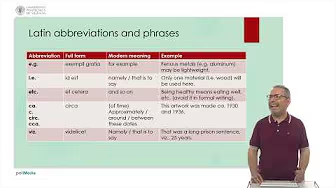
Título: Academic writing: Abbreviations Descripción: Seiz Ortiz, Rafael; Vídeo didáctico sobre un tema de redacción académica en inglés (Abreviaturas) Descripción automática: In this video, the presenter from the Department of Applied Linguistics at the Technical University offers an educational guide on the use of abbreviations in academic writing. The focus is on their importance in technical English, covering common Latin abbreviations and phrases, typical abbreviations in references and bibliography, and other abbreviations used in academic texts. The tutorial's objective is to illustrate the correct application of abbreviations, emphasizing that they should be conventional, formal, and agreed upon by the scholarly community. A distinction is made between abbreviations, which shorten single words or phrases, and acronyms that are composed of initial letters from a phrase. Examples of Latin abbreviations such as "e.g." for "for example," "i.e." for "that is," and "ca." for "circa" a