
The Hungarian-born electrical engineer, Dennis Gabor, who won the Nobel Prize for Physics in 1971 for his invention of holography, a system of lensless, three-dimensional photography that has many applications. A research engineer for the firm of Siemens and Halske in Berlin from 1927, Gabor fled Nazi Germany in 1933 and worked with the Thomson-Houston Company in England, later becoming a British subject. In 1947 he conceived the idea of holography and, by employing conventional filtered-light sources, developed the basic technique. Because conventional light sources generally provided either too little light or light that was too diffuse, holography did not become commercially feasible until the demonstration, in 1960, of the laser, which amplifies the intensity of light waves. In 1949 Gabor joined the Electrical and Electronic Engineering at Imperial College London, where in 1958 he became professor of applied electron physics. His other work included research on high-speed oscilloscopes, communication theory, physical optics, and television. Gabor was awarded more than 100 patents. In 2015, the Gabor Lecture was delivered by Regius Professor of Engineering Chris Toumazou, who discussed the future of healthcare based on the advances of microchip technology.
قد يعجبك أيضًا
Kids Songs by CoComelon
CoComelon
Learn Colors with CoComelon!
Year1 English
Alphabet (ABC) Songs by CoComelon
CocoMelon | Little Baby Bum | Blippi - Nursery Rhymes & Kids TV Shows
CoComelon - Happy Holidays
BabyBus | Learning Vehicles Song | Car Songs | Cars for Kids | Nursery Rhymes | Baby Cartoon
Learn English With Disney Movies
Test Your English with TV Series and Movies
CoComelon #shorts
All New Akili & Me
Funny Cartoons for Kids | Sheriff Labrador
Film Pendek Lucu
Year1 Music
Numberblocks Season 7
London Mathematical Society
JS 1 Business & Finance
BabyBus | Super Panda Rescue Team | Cartoon for Kids | Kids Animation
SS 2 English
AI, Technology and Society 2025
Jan Richardson's Sight Words List Course
Numberblocks Season 8
CoComelon & Friends Holiday and Christmas Videos for Kids | Little Baby Bum | Go Buster and More!
التعليقات
2 تعليق
Computer Technology has advanced spectacularly since the first program was executed by the Manchester Baby machine on June 21 1948, but if this progress is to be sustained there are major challenges ahead in the area. For more information please visit
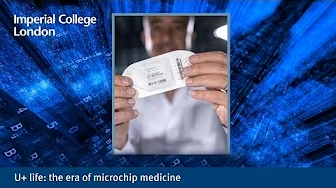
Regius Professor Chris Toumazou presents the 2015 Gabor lecture. Many countries are facing an ageing population and a rise in the chronic diseases associated with it such as diabetes, obesity, cardiovascular disease and kidney disease. Societies need to manage these better otherwise the financial costs will continue to escalate to unsustainable levels. To address these challenges, Regius Professor Toumazou has developed an innovative healthcare concept and brand called U+ Life. This harnesses the power of semiconductor technology and microchips for the treatment of chronic diseases. It provides personalised solutions for early detection, point of care diagnostics and therapeutics to help tackle the global problem of chronic disease in a consumer-oriented way. The U+ Life brand bridges lifestyle and epigenetics with applications ranging from the beauty industry to oncology. To find out more please visit